
The secrets tech recruiting firms use to hire faster

In France, 50.1% of hires are considered difficult by companies, according to France Travail's 2025 Workforce Needs survey. For tech profiles, the picture is even sharper: developers, data experts, and cloud engineers rank among the most sought-after and the rarest talent on the market. They're also profiles that are particularly hard and slow to hire.
Faced with this structural shortage, the (good) tech recruiting firms position themselves as accelerators. Their promise: identify, evaluate, and convince the right candidates before the competition does.
But concretely, how do they deliver on that promise for their clients? And what are the upsides of outsourcing tech recruiting to a specialized firm rather than hiring in-house? Here are the levers that make the difference.
As a tech and IT recruiting firm, Bluecoders shares its best practices and its "secret sauce" for quickly finding the candidates that are hardest to hire on the market.
What to remember:
- Tech hiring is especially hard in France because of a strong imbalance between company demand and the number of profiles actually available on the market.
- Tech recruiting firms reduce time-to-hire by 40% on average through specialized sourcing, precise technical evaluation, and easier access to the "hidden market" (candidates rarely visible on classic channels).
- Their main advantage is quickly identifying relevant profiles, where in-house hiring can be slowed down by a lack of pipeline, time, or technical expertise.
- Specialized firms adapt their approach to the company's stage of growth - startup, scale-up, or large enterprise.
- What sets a tech firm apart from a generalist firm is its fine-grained understanding of roles, stacks, market salaries, and what the targeted profiles expect.
- A successful hire is measured as much by time-to-hire as by hire quality, retention, and the reduction of mis-hire risk.
Foreword: why is tech hiring so complex in France?
The French tech job market suffers from a deep imbalance between supply and demand. Initial training programs don't produce enough graduates to cover the growing needs tied to digital transformation.
Some specialties - like cybersecurity, DevOps, or AI - see demand grow far faster than the rate at which talent is being trained.
That tension translates into a permanent war for talent. The best profiles are already employed, rarely actively looking, and approached several times a week on LinkedIn. Posting an ad on a classic job board is no longer remotely enough to catch their attention.
The technical bar further complicates the picture. Companies are no longer just looking for "a developer." They want a backend expert who knows a very specific stack, can integrate into an agile team, and contribute from their first week. That level of specificity makes IT sourcing particularly time-consuming.
Finally, many internal HR teams lack the technical literacy to evaluate applications properly. That difficulty understanding the skills involved creates gaps between the real need and the profiles presented to managers.

Access to the hidden market: a decisive advantage (secret #1)
More than half of hires in France reportedly happen through the hidden job market - that is, roles that are never posted on job platforms. For executives and experienced tech profiles, that share can reach 70 to 80%.
Tech-specialized firms have spent years cultivating a network of qualified candidates they personally know. These talent pools include developers, technical architects, data leads, and CTOs who never apply on job boards but stay open to good opportunities.
This continuous relationship work lets tech recruiters propose targeted profiles in a few days, where a classic search would take several weeks. The trust built with these candidates also smooths the early conversations and accelerates the decision.
For companies struggling to attract qualified applications, understanding this access to a pool of "hidden candidates" ends up tipping the scales when deciding to hire alone or work with a tech recruiting firm.
Technical evaluation: an essential filter to save time (secret #2)
A classic tech hiring process often involves 5 interviews stretched over several weeks. During that time, the most sought-after candidates sign elsewhere. We see it sometimes: a strong tech profile can accept an offer in 5 days. So you have to be very fast.
Specialized firms (like Bluecoders) compress those timelines through a rigorous technical evaluation carried out upfront. Before even presenting a candidate, the consultant verifies stack mastery, the coherence of their path, and their ability to integrate into the client's environment.
This upfront qualification eliminates unsuitable profiles from the start. The company then meets only relevant candidates, which significantly reduces the number of interviews needed and speeds up the final decision.
Important point to understand: a successful tech hire doesn't rest on the volume of CVs received, but on the relevance of the profiles presented from the very first round.
That selection rigor is precisely what sets the high-performing firms apart. To dig deeper, our analysis of tech hiring quality details the common traps that drag out timelines.
The sector expertise of tech firms is also a major asset. For example, who is better placed than a custom recruiting firm to hire data professionals?
Active sourcing: going to find talent rather than waiting for it (secret #3)
Posting an ad and waiting for applications is a strategy doomed to fail for in-demand tech roles. Tech recruiting firms practice active sourcing, also called "headhunting," which means identifying and contacting targeted profiles directly.
This approach relies on several complementary channels. Professional platforms like LinkedIn remain unavoidable. But specialized recruiters are also present in technical communities, like GitHub, Stack Overflow, or Discord. They attend meetups and conferences to meet candidates in their natural environment.
Another point: the effectiveness of active sourcing rests on the quality of the outreach message. A personalized first contact that mentions the stack used, the project context, and the technical stakes gets a far higher response rate than a generic message. Consultants who understand the technologies can hold a credible conversation with candidates.
Artificial intelligence is now reinforcing this work. More and more French companies have integrated, or plan to integrate, AI into their hiring processes - particularly for predictive matching between skills and opportunities.
Cultural alignment: an often underestimated accelerator (secret #4)
Hiring a technically excellent profile doesn't guarantee a successful hire. If the candidate doesn't fit into the team's culture, turnover kicks in within the first months, wiping out the benefit of the hire. You then have to start everything over, with months of delay and frustration…
Good tech recruiting firms systematically evaluate cultural fit alongside technical skills. They analyze the candidate's preferred working methods, their relationship with management, their expectations around autonomy, and their view of technology's role in the project.
This dual evaluation, technical and human, significantly reduces the risk of a bad hire. The cost of a failed hire can range from six to nine months of salary. By securing the fit from the start, the firm protects the company's investment.
For companies looking to secure their tech hiring, this combined approach is an indispensable safety net.
Adapting strategy to the company's growth stage (secret #5)
A Series A startup doesn't hire like a large enterprise. The stakes, the budget constraints, and the profiles needed differ dramatically depending on the stage of growth. A specialized firm adapts its hiring methodology accordingly.

- For an early-stage company, the priority is often to find versatile profiles who can wear several hats. The firm will steer sourcing toward entrepreneurial candidates, comfortable with ambiguity and motivated by the project. Employer brand plays a key role, because the startup has to convince without being able to compete on salary.****
- For a hypergrowth scale-up, the challenge is to hire in volume without sacrificing quality. The firm structures a repeatable process, with standardized evaluation grids and a continuously fed candidate pipeline.****
- Large enterprises, for their part, need a different kind of support: hunting rare profiles on niche technologies or hiring technical leaders capable of driving transformation.
At Bluecoders, we support these various contexts through our approach to tech hiring, designed to adapt to each organization's stage and ambitions.
What sets a good tech firm apart from a generalist (secret #6)
Not all recruiting firms are equal on tech profiles. The fundamental difference lies in sector specialization and a fine-grained understanding of technical roles.
A generalist firm knows how to hire an accountant or a salesperson, but will be lost facing a need for a DevOps engineer or a data engineer. They won't grasp the nuances between technical stacks, won't be able to evaluate the relevance of a path, and risk presenting unsuitable profiles.
The real value of a tech firm lies in its ability to translate a vague business need into precise search criteria, or to push back on an unrealistic brief before launching the engagement.
A tech recruiting firm has consultants who know the technologies, the market salaries, and the candidates' expectations. They can sharpen the initial brief, propose realistic adjustments, and sell the role credibly to demanding profiles. To better understand this strategic role, our profile of the tech IT recruiter details the key skills of these professionals.
Knowledge of the market also helps to anticipate trends. Which profiles will be in tension in 6 months? Which technologies are gaining ground? What salary levels do you need to offer to stay competitive? This strategic information saves companies precious time.
Concrete indicators of an accelerated hire (in-house vs. tech firm comparison)
Faster hiring isn't just a marketing promise. It's measured through specific indicators that specialized firms track rigorously.
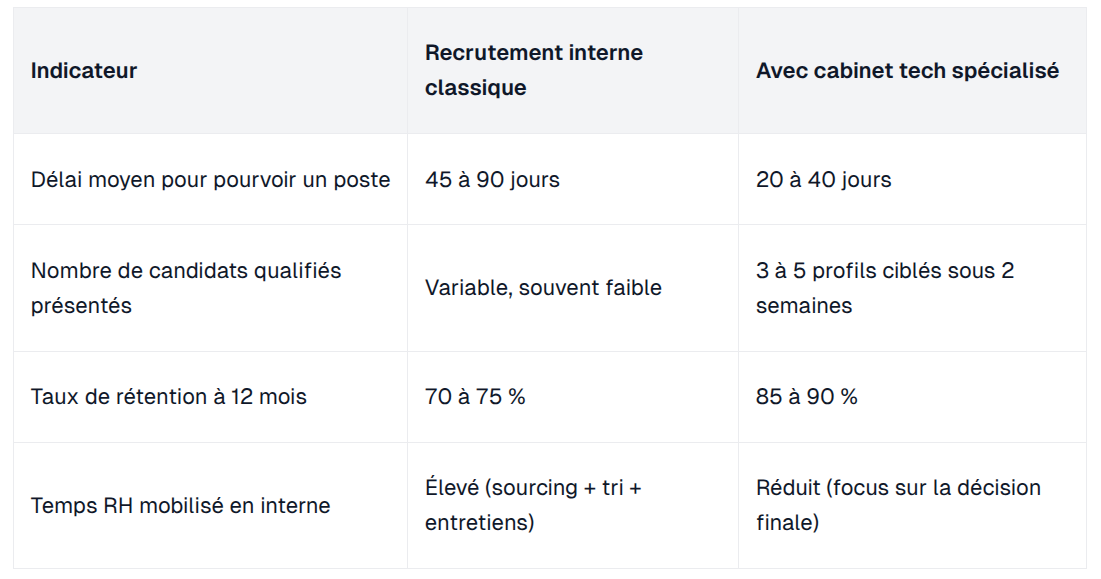
Time-to-hire is the most-tracked indicator, but it only tells part of the story. Hire quality - measured by retention at one year and the new hire's performance over their first months - reveals the real added value of the tech recruiting firm.
The cost per hire also has to be put in perspective. The firm's fees represent an investment, but they're offset by the reduction in vacancy time and the elimination of failed hires.
Conclusion
Tech recruiting firms concretely accelerate hiring in France through 6 levers:
- Access to the "hidden market";
- Technical evaluation upstream of HR interviews;
- Active sourcing in specialized communities;
- Factoring company/candidate cultural alignment into the evaluation;
- Adapting the hiring process to the company's stage of growth;
- And sector specialization in tech roles (vs. "generalist" recruiting firms).
In a context where more than half of hires are considered difficult, this expertise makes the difference between a role filled in 3 weeks and a role open for more than 4 months.
The key is to choose a partner who really understands your technical stakes, who knows how to evaluate skills beyond the CV, and who adapts their method to your context. Combining technical rigor and cultural alignment remains the best guarantee of a successful hire.
At Bluecoders, we combine technical evaluation and an understanding of team cultures to save you time on the rarest profiles. To build your next tech team, discover our approach and let's talk about your needs.
FAQ about tech recruiting firms
What is an IT and tech headhunting firm?
A headhunting firm specialized in IT and tech profiles is an external provider that knows how to identify, approach, and "win over" this type of candidate (on behalf of companies that have engaged them). Compared to a generalist recruiting firm, a tech firm has a better grasp of the roles, the stacks, the market salaries, and the candidates' expectations. That specialization lets them frame the need well, push back on an unrealistic brief, and present better-suited profiles.
What are the upsides of outsourcing tech hiring to a specialized firm?
Engaging a (good) tech recruiting firm gives you these benefits:
- Access to the "hidden market";
- Technical evaluations upstream of HR interviews;
- Active sourcing in specialized communities;
- Factoring company/candidate cultural alignment into the evaluation;
- Adapting the hiring process to the company's stage of growth;
- And sector specialization in tech roles.
How long does it take to hire a tech profile with a specialized firm?
On average, a specialized tech firm presents the first qualified candidates within one to two weeks. The total timeline from launching the engagement to signing the contract is generally between 20 and 40 days, compared to 45 to 90 days for in-house hiring.
How does a tech recruiting firm concretely reduce time-to-hire for hard-to-find profiles?
It moves faster on the steps that most often block companies hiring solely with their internal teams: identifying the right profiles, accessing a "hidden" pool, qualifying them technically, and crafting the outreach. The time savings come above all from better targeting, not a higher volume of CVs.
What is the hidden market in tech hiring?
The hidden market is made up of candidates who aren't actively applying but stay open to a good opportunity. It's a decisive lever in tech, because a large share of experienced profiles aren't visible on classic recruiting channels.
What is the cost of a tech recruiting firm compared to in-house hiring?
Fees generally represent 15 to 25% of the candidate's gross annual salary. That cost has to be compared to the total cost of a prolonged vacancy and the risk of a bad hire, which can reach six to nine months of salary.
How do you choose the right tech recruiting firm?
Favor a firm whose consultants have real technical expertise and know your sector. Ask for references on comparable engagements, check that they evaluate technical skills upstream, and make sure they understand your company culture beyond the job description.