
The Best Tech Recruitment Firms in France (2026)

Summary: In 2026, 72% of employers struggle to recruit tech profiles. Here is a comparison of the best tech recruitment firms in France (including Bluecoders, Licorne Society, Flaire, Pachamama, Bazylic, and Externatic), with the criteria for choosing the right partner to support you in 2026.
The tech recruitment market is going through a period of unprecedented tension. 72% of employers report difficulty hiring, according to the 2026 Talent Shortage Survey by ManpowerGroup. Artificial Intelligence skills have become the hardest to source globally. In France, finding developers, data experts, or cybersecurity specialists is often an uphill battle.
Faced with this reality, the best tech recruitment firms are no longer mere service providers but indispensable strategic allies for executing your roadmap. But each firm brings something different. And in all of that, it's hard to know which one really fits your need. This comparison of recruitment firms specialized in tech profiles is here to help you see clearly and identify the partner that fits your challenges (whether you're hiring a Staff Engineer for your startup, a Chief Engineer for your aerospace program, or a CTO to scale up your tech team).

Just in case: what is a tech recruitment firm?
A tech recruitment firm is an organization specialized in identifying, evaluating, and placing digital professionals. Unlike a generalist firm, it masters the specifics of technology roles: programming languages, cloud architectures, DevOps methodologies, the stakes of data and cybersecurity, and - for the most specialized - embedded environments, hardware, aerospace, or defense. To better understand these issues, see our resource on the role of a tech recruiter.
Its role goes well beyond simply posting job ads. The firm starts by deeply understanding the need: technical skills, seniority level, organization, team culture. It activates a network of qualified profiles, often already employed (data engineers, developers, infrastructure experts, embedded engineers, etc.), and therefore invisible on standard channels.
It knows the market realities: salary levels, stacks, candidate expectations, team dynamics. And above all, it allows you to move faster on hires where every week of delay has a real business cost.
The result: faster hires, and especially better-aligned profiles, which sharply reduces costly miscasts.
Why use a tech recruitment firm in 2026?
The French IT market is picking up again in 2026 with expected growth of +4.3% (according to the Numeum/PAC Observatory). This recovery intensifies the pressure on rare profiles. Companies find themselves in direct competition to attract the same talent. 64% of small and mid-sized businesses and 71% of mid-cap or large companies cite this competition as a difficulty factor, according to the BMO survey by France Travail relayed by Factorial.
In practice, this has very visible day-to-day impacts:
- projects falling behind for lack of resources;
- teams under strain absorbing the workload while waiting for the right hire;
- highly qualified profiles receiving multiple offers in parallel and signing elsewhere within days;
- lots of incoming applications… but few that are actually relevant;
- processes that drag on because the bar is hard to meet;
- or compromises made by default, with hires less aligned than planned.
Result: recruitment becomes a strategic topic, with a direct impact on a company's ability to execute its roadmap.
A specialized IT and tech recruitment firm addresses this challenge on several fronts. It has a qualified pool of passive profiles (data engineers, developers, infrastructure experts, embedded engineers, etc.) who don't respond to standard ads. It masters the sector's salary grids, technical stacks, and team-culture stakes. And it shortens hiring cycles for roles where every week of "vacancy" costs dearly in productivity.
2026 comparison of the best tech recruitment firms in France
The French market has many players specialized in tech and engineering recruitment. But they are not all equal… mainly because they don't all do the same thing.
Some are very specialized (data, product, executive), others cover a broader spectrum around tech and engineering.
Some work primarily with startups, others with large groups.
Some firms are very small (2 to 3 consultants), while others rely on real teams with distributed expertise.
This comparison is intentionally non-exhaustive. The goal is not to list every firm, but to give you concrete benchmarks for understanding who is relevant for your need.
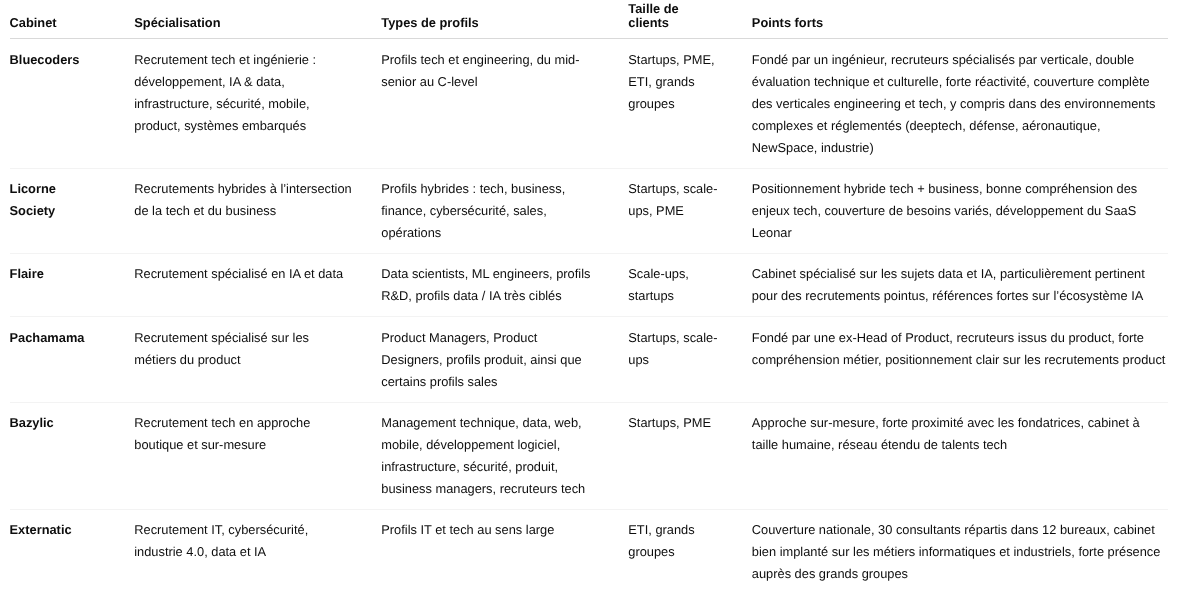
Bluecoders: covers Tech + Engineering, from mid-senior to C-level
Bluecoders was founded in 2016 by an engineer, Christophe Hebert, on a simple conviction: to recruit well in tech, you have to deeply understand the role, the stakes, and the concrete problems to solve. Today, the team counts about fifteen people, including around ten recruiters specialized by vertical (software, data/AI, infrastructure, embedded systems, etc.).
This setup makes it possible to cover a fairly broad spectrum of tech and engineering roles. Bluecoders works with startups (notably at Station F) as well as Industry 4.0 SMBs, in varied contexts: software, data, AI, but also defense, aerospace, deeptech, and hardware.
In practice, that translates into hires across several types of topics:
- AI & Data: as for WhiteCircle, Diago AI, Foodles, Greenspot…
- Founding Engineering: supporting early-stage startups on their first key hires (Tango, Crown, Konvu, Albert, Nopillo…)
- Defense & sovereignty: Safran AI (Engineering Manager, Product Manager AI & Algo), Cegelec Défense (Mechatronics R&D Lead, Systems & Networks Engineers), Agenium (3D Engineering Manager), Ophelia Sensors (Senior C/C++ Developer), Traak (Embedded Software Engineer), Wheere (PhD in Applied Mathematics)
- Deeptech & hardware: embedded engineers, C/C++, Rust, IoT, with hires at ZettaScale, Moba, Traak, Ophelia Sensors
- Tech management: CTO (Eskimoz, Crit, Les Sherpas, Singulier), VP Engineering (Zelty), VP Cloud & Platform Architect (Ornikar), Engineering Managers (Safran AI, Prestashop, Naboo, Dental Monitoring), etc.
Externatic: the firm for large groups
Founded in 2011 by Franck Gascard, Externatic is specialized in IT, cybersecurity, Industry 4.0, data, and AI roles. Based in Nantes, the firm operates nationwide with 30 consultants spread across 12 offices in France. Externatic works mainly with large groups, with references such as Maisons du Monde, La Poste, Bouygues, or Galeries Lafayette.
Flaire: an AI and data specialization
Founded around 2 years ago by Aymeric Serradeil and Adrien de Moulas, Flaire is a firm specialized in data and AI topics. It mainly works on highly technical profiles (data scientists, ML engineers, R&D profiles), notably within scale-ups. Among their clients: Mistral AI, Dust, Comand AI, Nabla, and Algolia.
Pachamama: a benchmark on product roles
Created in 2020 by Marion Darnet, a former Head of Product - making it the only recruitment agency founded by a product expert - Pachamama is a collective of independent recruiters based in Lyon. The team today counts 2 Co-CEOs (Marion and Arnaud), 1 Partner (Adeline, who runs the Sales BU), and 15 recruiters.
Their positioning is clear: recruit product profiles (Product Manager, Product Designer…) in startup and scale-up environments. Their strength: recruiters who come from product, with a real grasp of the underlying business stakes. Pachamama has also expanded its scope to Sales, a fast-growing BU.
Bazylic: a tailor-made approach
Bazylic was born from the partnership between Hélène Moisan and Amandine Dazy, two recruiters who, after working in recruitment firms and consulting, decided to launch their own tech firm to bring a tailor-made approach. A good fit if you want a close, direct relationship with the founders, with a wide network of talent in: technical management, data, web and mobile, software development, infrastructure, security, product, business managers, and tech recruiters.
Licorne Society: a hybrid tech + business positioning
Founded in 2020 by André Farah and Pierre Alexis Ardon, Licorne Society isn't limited to tech alone. That said, the founders' technical background is clearly reflected in how the recruiters are trained and in their understanding of tech stakes.
The firm also covers digital, finance, cybersecurity, sales, and operations, which lets it work on varied and sometimes hybrid needs. They have also developed Leonar, a SaaS aimed at recruitment teams.
Are there other tech-specialized partners worth considering (depending on your needs)?
Yes, of course. This list is far from exhaustive. Understand that the "best" tech recruitment firm doesn't exist in absolute terms. It all depends on your context:
- You're recruiting tech and engineering profiles in demanding sectors (space, defense, deeptech, cyber) → Bluecoders is the only one to cover this dual tech + engineering scope**** (with concrete references at Safran AI, Cegelec Défense, Hynaero, ZettaScale, Ophelia Sensors, etc.)
- You're looking for developers or classic tech profiles → Bluecoders, Mobiskill, Externatic, or Lity are safe bets.
- You're looking for a Product Manager or a Design profile → The Product Crew and Pachamama are the references on this segment.****
- You're building a data or AI team → Bluecoders, Flaire, Upward Data & IA, and Data Recrutement are best positioned.
- You're hiring both tech and business → Bluecoders, Urban Linker, Licorne Society, or Bessand cover both.****
- You're looking for a C-level for your scale-up → Sonnar is built for that, as is Bluecoders.
Our advice: what matters is working with a firm that understands your business, your culture, and your technical stakes. A good tech recruiter doesn't just match keywords on a resume. They know how to evaluate a profile's relevance against your stack, your organization, and your ambitions.

The 6 criteria for choosing your tech recruitment firm
Not every firm fits every situation. Here are the decisive criteria for making the right choice.
1. Their real understanding of your need
This is the most important point. Have they already recruited profiles similar to yours? Do they really grasp the stakes of the role, or do they stay at the surface? You should sense whether they understand:
- the differences between stacks (Java vs Kotlin, for example)
- the technical stakes (cloud, microservices, data, etc.)
- the concrete problems your future hire will have to solve.
2. Their track record and network
A network isn't built on LinkedIn in two weeks. Have they already worked with companies like yours? Who have they placed recently? Are these the kind of profiles you would have dreamed of having? Were they employed (active headhunting) or job-seeking (passive flow)? The more specialized the firm, the more recognized it will be in the ecosystem. Client testimonials are also a reliable indicator. A firm transparent about its results inspires more trust than one that stays vague about its work. For example, click here to discover Bluecoders' client case studies.
3. Their stability over time
This is often underestimated. How long has the firm existed? And especially: how long have the recruiters been there? If you have to re-explain everything every three months because the contacts keep changing, you waste enormous amounts of time.
4. Their way of working
"CV-spamming" is the cancer of tech recruitment. A good firm should save you time by filtering upstream.
When you receive a candidate, you should already want to meet them. Pay attention to their conversion rates: how many candidates sent vs. how many validated by the client? (A 1-in-3 ratio is a good indicator.) Ask questions: how do you qualify candidates? What do your outreach messages look like?
5. Image and communication
The firm is an extension of your company. If they contact candidates in a clumsy or aggressive way, your employer brand pays the price. Are they capable of selling your project without overselling? Look at:
- their outreach messages → personalized or copy-paste?
- their stance → able to sell your project without overselling?
6. Fit and trust
You're going to work with them for 2 to 3 months. Transparency is key.
- Do they dare to challenge you (salary, process, requirements)?
- Are you comfortable giving honest feedback, even negative?
If the relationship isn't healthy from the start, it won't hold over time.
Common mistakes to avoid when choosing an IT/tech recruitment firm
Choosing a firm purely on price is a classic mistake. Low fees can mean shallower sourcing, less experienced consultants, or a limited pool. The cost of a hire is between 18% and 25% of the role's annual salary (sometimes more for particularly hard-to-find profiles). But a failed hire costs three times more once you add up the new recruitment process, the impact on the team, and the project delay.
Another trap: stacking firms on the same role can seem like a good idea to speed things up. But it often creates confusion, duplicate applications, and a degraded candidate experience. It's better to invest in an exclusive, well-framed partnership with a firm that truly knows your ecosystem.

What sets a top tech firm apart from a generalist player
Companies are diversifying their criteria: soft skills, open-source projects, and GitHub contributions count as much as a degree. A generalist firm often misses these signals. They mostly evaluate a resume, where a tech specialist evaluates a complete technical profile.
Top tech firms stand out on 2 fronts:
- Knowledge of the market and tech stakes: up-to-date salary benchmarks, understanding of technical environments, ability to read the coherence of career paths (career changes, bootcamps), monitoring of emerging technologies, network of profiles quickly "mobilizable," ability to challenge candidates.
- End-to-end support: from the initial brief to onboarding, including probation follow-up, to reduce the risk of early departure and make sure the new hire "matches" the company culture.
This is exactly the approach we apply at Bluecoders. We combine technical-skills evaluation with human-fit analysis to maximize the chances of finding the right profile (the one who will stay beyond the probation period!).
"When you only do tech for several years, you see how the market evolves, you understand the stacks, the organizations, the issues. That's the real difference."
Cécilia Fille, COO and tech recruiter at Bluecoders
Specialized firm or in-house recruitment: which to choose?
The question is fair, especially for companies with an in-house HR team. In-house recruitment has the advantage of knowing the company culture. But it often runs into a lack of network in the tech ecosystem, very long hiring cycles, and difficulty evaluating the most technical skills. To dig deeper into this, our article "in-house or external recruitment: which to choose?" details the pros and cons of each approach.
A specialized firm brings 3 key elements: access to passive candidates (those highly solicited tech profiles who don't apply), a technical evaluation, and a speed of execution that often makes the difference in a market where the best candidates disappear within days. This is even more true in engineering and regulated sectors (defense, space, deeptech), where profiles are rare, security requirements are high (clearances), and internal pools are often limited.

How to maximize your collaboration with a tech recruitment firm?
Choosing the right firm is one thing. Working well with them is what makes the difference.
1. Be clear (really) about your need
The more precise your need, the more effective the firm will be.
Not just a generic job description, but:
- the team context;
- the stakes of the role;
- what's non-negotiable vs. what's flexible.
Get the Tech Lead or CTO directly involved.
Technical nuances matter enormously: between "we do React" and "we're migrating a monolith to micro-frontends," it's not the same hire.
And above all: sell your problems, not just your perks.
Strong profiles are looking for challenges, not polished job descriptions.
A good brief is already 50% of the work.
2. Be responsive
The tech market moves fast.
A good candidate can sign elsewhere within days.
If it takes you 10 days to give feedback, you're already late.
In practice:
- give feedback quickly after each interview (ideally < 24h);
- chain steps with no dead time;
- avoid overly long processes.
And above all, be precise in your feedback.
"Not enough XP" isn't enough. Say instead: "lack of mastery on event-driven architecture."
Speed is your only weapon against very attractive companies.
3. Play it transparent
A firm can't help you well without visibility.
Be clear about:
- your real budget (fixed, variable, BSPCE);
- your internal constraints;
- your doubts about certain profiles.
Nothing breaks a collaboration more than a bad surprise at the end of the process.
Share your technical test too. The firm can prep candidates… and flag if it's too long or off-putting.
4. Accept being challenged
A good firm doesn't just deliver resumes. They should also tell you:
- if your salary is below market;
- if your process is scaring candidates away;
- if your need is poorly framed.
It's uncomfortable, but it's often where you save the most time.
5. Treat them like a partner
The more you bring the firm into your thinking, the more effective it will be.
Share:
- your roadmap;
- your business stakes;
- your product / tech vision.
The recruiter then becomes able to defend your project with conviction in front of candidates.
6. Avoid stacking firms
Working with several firms can feel reassuring. In reality, it creates:
- duplicates;
- a poor candidate experience;
- less commitment from each firm.
And above all, it pushes everyone to favor speed over quality.
Better one good partner, truly committed, than several firms in parallel.
If you trust them, give a short exclusivity (2 to 3 weeks) with a clear framework.
The real secret
Treat the recruiter as an internal member of your team.
The more they understand your stakes, the more able they'll be to convince a candidate hesitating between several offers.
Questions to ask before committing
Before signing with an IT/tech recruitment firm, don't hesitate to ask these essential questions:
- What is your concrete experience on profiles similar to ours (stack, seniority, sector)?
- How long have you been doing this job? And how long in tech?
- What tools and methods do you use to evaluate technical skills?
- How do you assess cultural fit between the candidate and our team?
- What's your average time to present the first qualified candidates?
- Can you provide verifiable client references in our sector?
- Do you work on success or with a retainer?
- __Do you offer post-onboarding follow-up?
Clear, quantified, transparent answers are the sign of a serious partner. A firm that hesitates or stays vague about its methodology deserves to be challenged with other options.
Key takeaways
Choosing among the best tech recruitment firms in France isn't just about comparing fee grids. Sector specialization, evaluation quality (technical and cultural), process speed, and the ability to support your growth strategy are the real differentiators.
In 2026, the stakes of tech recruitment in France have never been higher. The shortage of skills in AI, cybersecurity, and data shows no sign of slowing, and every week lost in an inefficient recruitment process represents a considerable opportunity cost. Choosing the right tech firm above all means choosing a partner who understands your technical stakes as much as your team culture, and who can act quickly across the full spectrum of tech roles.
In short, don't choose a firm for what it will cost you. Choose it for its ability to deeply understand your need… and to think like your CTO while acting like your HR right hand.
At Bluecoders, it's precisely this combination of technical expertise, human evaluation, and 100% success-based model that makes the difference for our clients. To build your next tech or engineering team with tailor-made support, discover the tech sectors we recruit for and let's talk about your needs.
Frequently asked questions
What budget should I plan for a tech recruitment firm?
Tech recruitment firm fees generally fall between 18% and 25% of the candidate's gross annual salary. For a specialized firm, fees are around 25%.
In concrete terms, here's what that means:
- For a manager profile at €50,000 gross: plan between €9,000 and €12,500 excl. VAT.
- For a tech leadership role at €120,000: count around €30,000 excl. VAT.
Beyond the invoice, the real calculation lies in the cost of an unfilled position. According to SHRM, prolonged vacancy or a failed hire costs between 50% and 200% of the annual salary, on top of lost team productivity (estimated at 20-30%). A position vacant for 4 months ends up costing far more than the fees of an expert.
Good to know: Unlike retainer-based models (1/3 at signing), Bluecoders works 100% on success. No hire, no invoice. This guarantees total alignment of our interests with yours.
How long does it take to recruit a tech profile through a firm?
While the average time in France ranges between 12 and 15 weeks, expertise can divide those numbers. At Bluecoders, the median time-to-deal on our 2026 placements is 22 days (between opening the role and offer acceptance).
- Data & Dev profiles (JS, Python): regularly under 3 weeks.
- DevOps or Lead profiles: count 45 to 60 days.
- Leadership roles (Chief Engineer): about 3 to 4 months.
The key factor: What slows the process isn't the rarity of the profile, but the company's responsiveness. A top candidate leaves the market in 10 days. If your process drags out over 5 weeks, you'll systematically lose the best ones. Our consultants help you structure fast, sharp selection steps.
Can a tech recruitment firm work with a startup at the seed stage?
Yes, provided you choose a partner who understands early-stage agility. A seed-stage startup has vital needs: tight budget, versatile profiles, and total cultural fit. A firm used to large accounts risks missing these specifics.
The fatal mistake is to recruit in a rush without a 12-month vision. A bad first tech hire is financially expensive (30% of the annual salary), but mostly impacts the energy and confidence of the founding team. Bluecoders adapts its method here: tighter qualifications and focus on maturity/profile fit.
What's the difference between a tech-specialized firm and a generalist firm?
The numbers speak for themselves: according to LinkedIn Talent Solutions, specialized firms post a placement rate 30% higher than generalists, with final success rates between 80% and 90%.
The difference? Technical understanding. A specialized recruiter knows how to read between the lines of a career path, evaluate real mastery of a stack, and detect potential on demanding roles (embedded, hardware, aerospace). Where a generalist plays the volume game, the specialist plays on technical relevance.
Tech firm vs. recruitment platform: what's the difference?
The choice depends on the support you need:
- The Firm (Human & Advisory): It's a full delegation. We hunt passive profiles (those not looking for a job), convince them, and advise you on market reality. You pay for expertise and saved time.
- The Platform (Tool & Autonomy): It's a search engine. You identify profiles, but you handle qualification and closing alone. It's less expensive but very time-consuming for your teams.
In short: with a firm, you buy a result; with a platform, you buy access.
Which tech recruitment firm for fast hires without sacrificing quality?
Speed isn't a question of volume but of targeting. Rather than send you 30 resumes to sort, Bluecoders selects 3 to 5, ultra-qualified.
This responsiveness rests on our pool: by working daily with engineers, we already know the candidates before your role even opens. It's this groundwork that makes it possible to present relevant profiles in just a few days.
Which recruitment firms for rare profiles (AI, data, embedded)?
The AI market is booming: with 166,000 AI job openings in 2024 already, demand is shifting toward hybrid profiles (ML Engineers, LLM specialists, Prompt Engineers). On these in-demand roles, Bluecoders positions itself as a leader alongside players like Flaire or Upward Data & IA.
Which recruitment firms for DevOps, security, infrastructure profiles?
These profiles are the most complex to capture because they require dual technical and product competence. Bluecoders has a documented track record on this segment with strategic placements:
- Head of SRE at GitGuardian.
- Lead DevOps at Frichti.
- Infrastructure experts at Slimpay, Stoïk, ADN, or Hexagone.
Does Bluecoders recruit in defense, aerospace, and space sectors?
Absolutely. A partner of GIFAS and GICAT, Bluecoders has built sharp expertise in DefenseTech and NewSpace over the past 3 years.
We recruit for major players (Safran AI, Cegelec Défense) and Deeptech gems (Agenium, Traak, Wheere). We master the constraints specific to these sectors: security clearances, critical certifications, and hybrid software/hardware profiles.