
Tech Recruitment 2026: Real Recovery or False Hope?

Only 46% of French companies say they plan to hire in 2026, compared to nearly 78% in 2024 (source). This figure reflects a job market in flux. For its part, the tech recruitment market in 2026 sits in a paradoxical context: demand is exploding for strategic tech skills, while budgets remain constrained and employer selectivity is higher than ever.
The hiring of IT and tech profiles should rebound in 2026 after two transition years. Industrialized AI, regulatory cybersecurity, sovereign cloud: the projects frozen in 2024 and 2025 are getting back onto roadmaps. But the rules of the game have changed. Understanding these new dynamics has become indispensable to hire the right tech profiles, at the best moment, and with the right level of demand.
This article is a summary of tech market trends in 2026. It's based on concrete numbers as well as on what we observe every day in the field with candidates and the companies hiring them. Bluecoders is a recruitment firm specialized in tech and engineering profiles.
Article updated on 22/06/2026.
Key takeaways:
- Tech recruitment in 2026 is on the rise again after two years of contraction, with 42% of IT companies planning to hire on permanent contracts (but with unprecedented selectivity on profiles).
- The tech recruitment market is undergoing rapid, structural transformation.
- Three dynamics are pulling the market in 2026: the industrialization of AI, the rise of cybersecurity and compliance requirements, and the comeback of industry and critical systems.
- The most sought-after profiles in 2026 are fullstack, DevOps/Cloud, Data and ML Engineers, cybersecurity experts, solution architects, and Product Managers.
- Generalist development - front, back, or fullstack - is under stronger pressure, with less volume, more demand on seniority, and a higher expectation around product and business understanding.
- The market increasingly values hybrid profiles at the boundary between software, data, industry, and the business - notably on new uses tied to AI and Industry 4.0.
- Salary transparency is becoming a more important attractiveness lever, with more visible compensation ranges in job postings.
- Tech recruitment processes are structuring themselves around concrete proof: structured interviews, case studies, design documents, live debugging, pair programming, and scoring grids.
- To recruit effectively in 2026, companies have to make their stack visible, structure their evaluation, and lean on real expertise in tech recruitment.

A tech market in recovery, but profoundly transformed
According to the annual barometer from Numeum (the French digital industry association), French startups created 25,000 jobs in 2025, i.e., +6.1% annual growth. A figure that looks solid on the surface, but that percentage was twice as high in 2021 and 2022, and was still +9.1% in 2023. Growth is slowing, without stopping.
The view is shared by job platforms. This trend reflects a generalized slowdown in the French tech recruitment market since 2023: −13% offers and +20% applications. The scissor effect is clear. More candidates are competing for fewer roles. The number of applications per offer rose from 32 in 2023 to 56 in 2025.
That said, the views are unanimous: a stirring seems to be starting in early 2026. Hellowork notes, for instance, a +3% rebound in offer volume between late 2025 and early 2026. The direction is clear, even if the size of the recovery remains modest.
The three engines pulling demand for tech profiles
Three structural trends are fueling the restart of tech hiring in France. They redraw the map of sought-after skills and create new tensions on very specific profiles. We're not just talking about a cyclical slowdown - we're facing a shift in value, in usage, and in the profiles being sought.
1 - Industrialized AI, beyond prototypes
Generative AI is no longer a topic to monitor: it has entered operational practice. Today, the question is no longer "is the company using AI?". It's become a prerequisite. In many cases, it's even an investment condition. Funds systematically question companies on their AI usage, and overly "classic" models are increasingly underfunded.
Direct consequence:
The most sought-after profiles are no longer just "pure" developers, but profiles capable of:
- integrating AI into existing systems
- operating pipelines (MLOps, DataOps)
- connecting tools and models to concrete uses
You can already see this shift in hiring: AI Engineer, MLOps, AI Backend, Data Product Manager, Forward Deployed Engineer… Value is moving from producing code to orchestration, integration, and business impact.
2 - Cybersecurity and regulatory compliance
The restart of automation projects, the integration of generative AI, and the growing stakes around cybersecurity should restart demand for IT talent.
Two regulatory frameworks are accelerating this movement: the NIS2 directive (transposed into French law) and the DORA regulation for the financial sector. Companies are therefore looking for cybersecurity experts capable of leading compliance, risk governance, and business continuity plans.
What's more, in 2026, companies are taking back projects left fallow: sovereign cloud, architecture overhaul, securing data flows, automating data chains.
3 - The comeback of industry and critical systems
In parallel, we observe a massive shift of value toward industry. Since 2023:
- jobs tied to "tertiary" software are slowing
- jobs tied to industry, robotics, and physical systems are exploding
We're talking about growth that can reach +200% on certain segments.
A good example: Industry 4.0. This market is seeing very strong growth:
- +15% to +20% per year
- ~$130 billion in 2023
- projection between $370 and $400 billion by 2030
These companies aren't hiring "classic" devs. They're looking for profiles capable of connecting the physical world with the software world.
Watch-out: "classic" development under pressure
The market for hiring generalist developers (front, back, fullstack) has slowed sharply. Some estimates speak of -70% activity on these profiles in certain segments.
At the same time, tools like code assistants (e.g., GitHub Copilot or new environments like Claude Code) accelerate production and reduce the need for purely executing profiles.
What this concretely changes:
- less volume on classic dev profiles
- more demand on senior profiles
- and a strong expectation around the ability to understand product and business
The developer who only executes tickets becomes less differentiating, even as other profiles now stand out. Speaking of which - let's talk about them.
The most sought-after tech profiles in 2026
42% of IT and Tech companies plan to hire on permanent contracts in 2026, according to a Robert Half study relayed by Tool4Staffing. But needs concentrate on very specific skills.
Here are the role families with the highest tension:
- Fullstack developers: React/Node, Python/Django. The frontend/backend combination remains the most-demanded foundation.
- DevOps and Cloud engineers: AWS, Azure, GCP. The pivot toward Platform Engineering is transforming the scope of these roles.
- Data Engineers and ML Engineers: industrialization of pipelines, data quality management, CI/CD for models.
- Cybersecurity experts: SecOps, GRC, IAM/Zero Trust. NIS2 and DORA obligations are multiplying dedicated roles.
- Solution architects and Product Managers: hybrid profiles capable of bridging technical stakes and business vision.
The market rewards technical specializations (Data, API) or sector specializations (Fintech, e-commerce). More than ever, it's becoming elitist and values hyper-competence.
👉 To go deeper on the question of expected experience levels, we published a complete guide on how to hire a junior or senior tech profile.
The emergence of new hybrid roles
A concrete case illustrates this evolution well: a company like Ematica, specialized in industrial intelligence, builds solutions to connect factory machines to real-time data systems (notably around AVEVA's PI System).
Their goal: turn sensor data into operational steering tools.
Concrete applications:
- predictive maintenance
- energy optimization
- improving industrial performance
The profiles sought are very specific: Lead Solutions Engineer, IT/OT integration, industrial data…
These are rare profiles, at the boundary between:
- software
- data
- industry
And that's precisely where value is being created today.
Juniors, seniors, or managers in tech: very different realities
The market doesn't treat all profiles the same way. The disparities between experience levels widened in 2025 and continue into 2026.
A tough market for juniors
Access to the job market is getting harder for young people, with the marked decline in apprenticeship and work-study offers. Entry-level profiles face heavier selection processes and international competition on generic stacks. That said, the "AI natives," trained from the start on an agentic stack, represent a promising pool for companies ready to invest in onboarding.
Seniors and experts in a (relatively) strong position
Expert and hybrid profiles able to combine technical strength with business vision are the most sought after. The ideal for many companies remains a confirmed profile (8 to 12 years of experience), operational and autonomous, without necessarily having managerial ambitions.
👉 To calibrate your strategy properly, we detailed how to adapt your tech hiring to your growth stage.
Management on the back burner
Organizations now favor high-level individual contributors. The emphasis is on "build" - on the ability to ship and demonstrate measurable impact, rather than on team coordination and management itself. This trend should push candidates to document their results in a quantified, verifiable way.
Tech salaries 2026: gaps that are widening
Talking about an "average IT salary" doesn't make much sense anymore in 2026. Compensation varies considerably by location, expertise level, sector, and contract type.
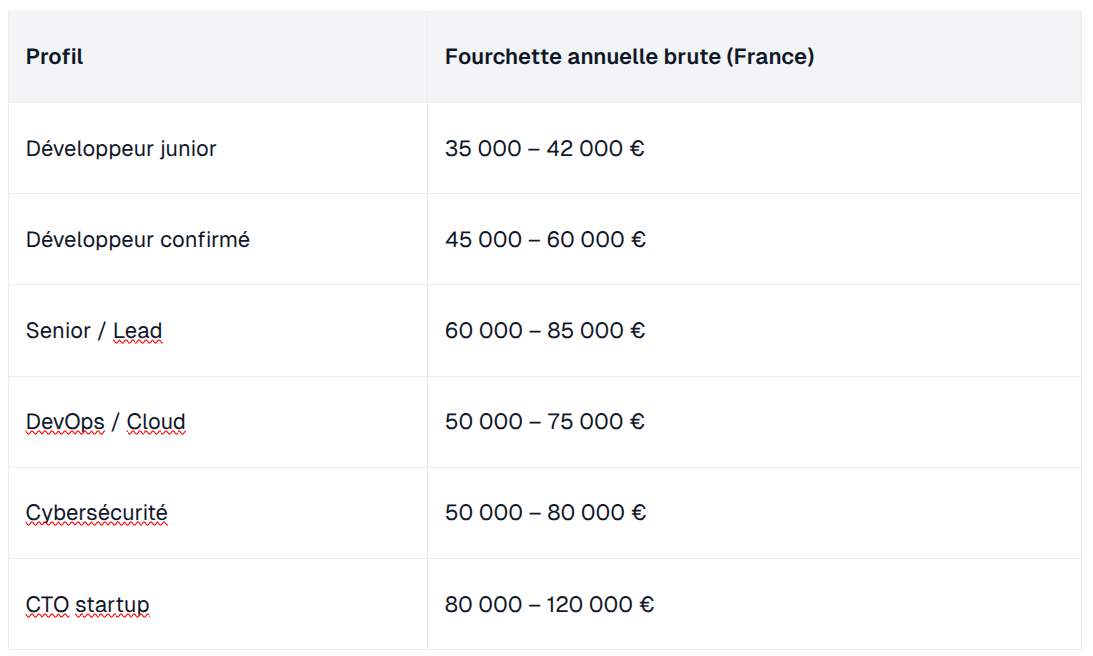
An influx of candidates, often coming from consulting or freelancing and seeking the stability of a permanent role, lets companies be more selective and rationalize salaries. In Île-de-France in particular, Fed IT notes a marked slowdown in IT hiring that flips the balance of power, according to Le Monde Informatique.
The European directive on salary transparency is also changing the game. With this directive coming into force, salaries gain visibility in job postings in 2026. For recruiters, displaying a realistic, competitive range becomes an unavoidable attractiveness lever (as highlighted by Indeed Hiring Lab's 2026 report).
On the recruitment process side: proof above all
By the end of 2025, nearly 8 recruiters out of 10 (78%) use generative AI in their work, almost double a year ago (according to a Hellowork survey relayed by Tool4Staffing). A figure that has nearly doubled in one year.
Matching, scoring, CV sorting: the first filters are being automated. But the human bar has never been higher.
Gone is the freestyle interview. Gone are the profiles with gaps and grey areas. Make way for rational, evidence-backed, reproducible evaluation. The formats taking hold in tech recruitment processes are now structured:
- Structured interviews with a scoring grid at every step.
- Case studies blending technical constraints with business stakes.
- Incident reviews (SRE or cyber) analyzed live.
- Design documents: producing then discussing an architecture.
- Live debugging and collaborative pair programming.
We designed our playbook of technical tests to evaluate your candidates precisely to help teams put this kind of structured process in place (adapted to each seniority level).
A direct transformation of recruiters' role in tech
For recruitment firms, these tech-market changes are structural.
Two options:
- absorb the decline of the historical market
- or immediately ramp up on these new roles
That implies:
- understanding new technical environments (industry, AI, embedded systems)
- identifying less visible profiles, often outside the usual circuits
- adapting headhunting methods
Teams have to evolve, either by:
- hiring specialized recruiters
- ramping up quickly in-house
4 levers for successful tech hiring this year
Faced with a more demanding market, companies that hire effectively share several common traits.
Lever #1: Make the technical stack visible
Developers evaluate their future employer before even applying. Publish your stack, share technical articles, contribute to open source: all signals that attract qualified profiles. Building a true engineering culture is a competitive advantage.
👉 We detail this approach in our article leaning on tech culture to recruit the best talent.
Lever #2: Structure the evaluation process
Recruiters conduct on average 8 interviews spread over 39 days before filling a role. Processes tend to lengthen, a sign of more cautious and more collaborative decision-making. A clear, calibrated process communicated from the first contact reduces drop-off along the way.
Lever #3: Offer flexibility and transparent compensation
Hybrid or full remote work has become a major decision criterion for tech candidates. Combined with a salary range shown right in the offer, this transparency speeds up decision-making.
Lever #4: Surround yourself with tech recruitment experts
21.8% of trial periods on permanent contracts end in termination, twice as many as in 2007. Limiting casting errors goes through rigorous evaluation, combining technical skills with cultural alignment.
Tech recruitment outlook for 2026: a tougher market, but more readable
Tech recruitment in 2026 doesn't mark the return of euphoria. It's a recovery, yes - but not one of opulence. This restart shows itself more lucid, more selective. More operational.
Companies are no longer just trying to fill a role. They're investing in strategic skills that will directly contribute to their resilience and competitiveness.
We're moving from a market centered on classic software development to one structured around:
→ AI
→ integration
→ complex systems
→ industry
In short:
- Less volume, more demand
- Less execution, more impact
- Fewer generic profiles, more hybrid experts
For employers, the key lies in the ability to combine speed of execution, evaluation rigor, and the attractiveness of the value proposition. Selection processes become showcases of company culture.
Candidates, for their part, must prove their impact, ramp up their skills (notably on AI topics), document their accomplishments, and refine their positioning.
It's precisely this dual demand (technical and human) that guides our approach at Bluecoders: combining mastery of tech stacks with cultural alignment to secure every hire.
If you want to structure or accelerate your next hires, discover our support to secure your tech recruitment process.
Frequently asked questions
Which tech profiles are hardest to hire in 2026?
Engineers specialized in cybersecurity (SecOps, GRC, Zero Trust), ML Engineers able to industrialize AI models, and Platform Engineers are among the most in-tension profiles. The combination of deep technical expertise and business vision (hybrid profile) makes these hires particularly competitive.
How long does a tech recruitment process take in France?
On average, a tech hire mobilizes 8 interviews over 39 days. Processes have lengthened relative to previous years due to increased selectivity. Structuring your steps and communicating a clear timeline to candidates significantly reduces drop-off.
How can hiring mistakes on technical roles be limited?
Evaluation must combine contextualized technical tests with verification of cultural fit. At Bluecoders, we cross-reference skill analysis with alignment to team values to reduce trial-period terminations. Structuring a reproducible process, with scoring grids, is the most reliable method.