
How to manage a replacement on a tech team

In these uncertain times, the job market is fairly unfavorable to employers. Many roles stay vacant for too long.
Your developer might leave, your CTO may ask you to replace them and find a carbon copy of your former developer… But nothing's working - you can't find the ideal developer.
You're not alone. Many of our clients at Bluecoders tell us about the same struggle. In this article, we'll explain why replacing an employee can be a real cost for your company and how best to find the ideal developer for your team.
Limiting your developers' turnover is essential
In the current context of a shortage market, finding and keeping the best employees is vital for your organization to thrive.
It's especially hard for smaller entities that have to compete with bigger ones with bigger budgets, which lets them attract the best talent.
You know it well: once you've found a "rockstar" developer, the key is not to let them leave.
To prevent that, annual salary isn't the only way to compete with big groups. Personalized perks based on your employees' needs can be a lever to lower turnover.
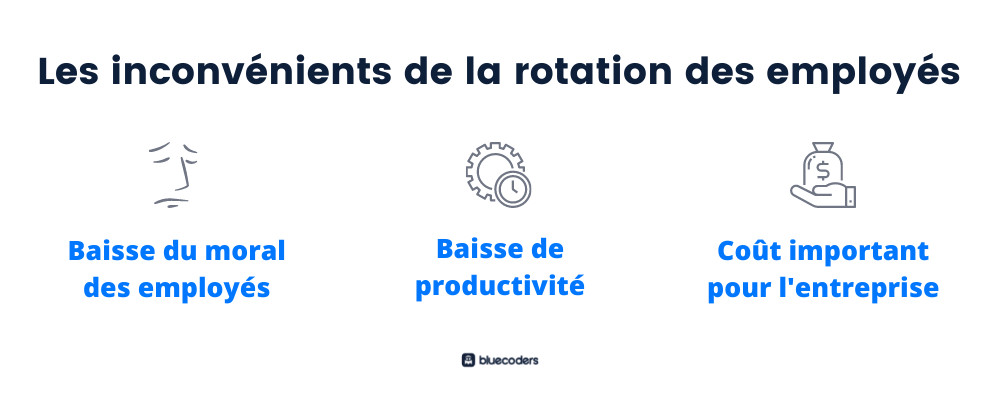
Employee turnover is generally bad for your company:
- Turnover can hurt employee morale: one of the first noticeable changes on a team after a departure is the drop in overall morale. The culture and engagement of your other employees can take a hit.
- Employee turnover lowers productivity: the departure and replacement of an employee - particularly a tech employee - necessarily leads to a drop in team productivity. Fewer employees are available to handle the work, and you spend time and energy finding a replacement for the tech person who just left.
- Turnover is expensive for your company: turnover within your teams has a cost. Recruiting, training, and onboarding new employees represents a significant financial cost.
The average cost of losing an employee can run to thousands of dollars. On average, replacing an employee costs between 6 and 9 months of salary.
Handling a developer's departure
Before replacing a team member, it's important to understand why they left, in order to avoid further departures that could seriously hurt your company's future.
Why does a developer leave their job?
There are many reasons why an employee may leave their current role. Among them:
- A lack of career development opportunities
- A lack of employee engagement
- A poor company culture
- The absence or insufficiency of social benefits and annual compensation
- Disagreements with colleagues or leadership
- The absence of clear objectives or direction for the company
- Employees feeling that their feedback or ideas aren't taken into account.
You can act on these factors. To counter these frustrations, you can offer clear and attractive career plans, ongoing training, differentiating perks, or build a strong employer brand - notably by training your non-tech teams (like HR and managers) on tech culture.
Your developers will finally feel heard and understood.
Once you've identified why your dev left, escalate it and prepare an execution plan to limit further replacements.
Anticipate the departure and assess the need for a new developer
Your lead dev is leaving. They told you recently and you now have the notice period to anticipate the departure.
After analyzing the reasons behind the choice, it's time to start the search for a new developer.
First and foremost, it's essential to understand that you won't find two devs that are alike. If your CTO makes you think otherwise, get them to accept the differences and the upside of getting a fresh perspective on building your service or product.
Next, it's important to assess your company's hiring need. That will help you build a clear, precise job description.
At this stage, realism is the watchword! Your CTO wants a back-end developer with 10 years of experience in PHP and Python, who has worked at Google or Facebook, and all of that for the modest sum of $45K a year?
Don't go looking for the goose that lays golden eggs - that profile doesn't exist. Assess the company's real needs and define the ideal profile while identifying the possible areas of compromise.
Some prerequisites will be deal-breakers (the programming language, for example), others less so (they didn't go to Google, but to a fast-growing proptech).
If your manager still isn't convinced, start by asking questions like:
"If the person has 10 years of PHP experience without much exposure to Python, does it really matter?",
"Why would a dev with that kind of experience agree to work for us?",
"In your opinion, how much does a back-end developer at Google cost?",
"What do we have to offer them?"…
So many questions that will help dial down the requirements and fine-tune the right profile of the developer you're missing.
Going on the hunt for your developer
Once your hiring need is clearly identified and the ideal profile defined, it's time to execute your plan.
First, use your network and your candidate database to scan potential candidates.
Then post a job description that's both clear and precise. Finally, in early interviews, keep in mind that the current context is more unfavorable to employers than to tech employees. So it's important that the candidate actually wants to work for you.
To do that, you have to manage your tech people's careers from hiring to growth and all the way to departure. Tracking your employees' career progression also boosts retention.
If you can't recruit from your candidate pool or your internal referral network, you can also switch to active sourcing and bring in tech recruiting experts like Bluecoders.
Outsource your hiring
Bringing in experts like Bluecoders gives you access to the best tech pool for your company. Bluecoders is a recruiting firm specialized in tech, where the recruiters actually know what they're talking about. Your candidates will tell you: "Finally, a recruiter who knows what they're talking about!".
At Bluecoders, we both train recruiters on the specifics of tech recruiting and support IT profiles in their careers by presenting them with opportunities aligned with their ambitions.
Organize the handover
Once the ideal candidate is found, it's time to organize the handover. We recommend not waiting until your former employee's last day to onboard their successor.
The handover is an important moment and a major time- and money-saver during a role replacement.
The point is to put sharing and knowledge transfer at the heart of the conversation. You can also support this period with documentation that the outgoing colleague will have prepared in advance to best guide their replacement.
When the departure comes, stay in touch with the employee
The departure is approaching. Before the farewell drinks that wrap up your developer's experience on your team, make sure to gather their final impressions.
Like a check-in, schedule a conversation to collect their take on the team, the company, the processes, and their work. Their words will be freer and their feedback will help explore areas for improvement in your company and your team.
Once the equipment and credentials have been recovered, don't forget to stay in touch with your former team member. It's always good to follow your former colleagues' growth and stay connected with them.